 search
 language
 menu
menuExplanation of work visas required for foreigners to work in Japan

If you want to live in Japan for a long time in the future, you need an income.
You cannot work in Japan simply by entering the country as a tourist.
You must obtain a visa to work in Japan.
Here we will explain the work visa required to work.
Contents
Status of Residence
A status of residence is required for foreigners to stay in Japan for more than 90 days.
The status of residence for the purpose of working is called a “work visa.
The following is an explanation of the types of work visas.
Types of Work Visas

Without a work visa, you cannot work in Japan and receive income.
Once you receive a work visa, you are not free to work in any type of work you like, but are classified in detail according to the type of work.
There are currently 16 types of work visas.
Work visas have a fixed expiration date and can be renewed depending on the type of work visa.
| Specified Skills | Those who engage in work that requires a considerable degree of knowledge or experience in a specific industrial field. There are two types of visas: Specified Technical Skill No. 1 and Specified Technical Skill No. 2. |
| Skills | (Cook (of foreign cuisine), pilot, sommelier, etc. |
| Technical/Humanities International work |
IT technician, interpreter, foreign language teacher, copywriter, designer, etc. |
| Intra-company transfers | Transfer from an overseas branch office to a branch office in Japan (e.g., head office), etc. |
| Management | Company manager, president, board member, etc. |
| Professor | University professor, assistant professor or research associate, etc. |
| Art | Songwriters, composers, painters, craftsmen, photographers, etc. |
| Religion | Missionaries, Bishops, etc. |
| Press | Newspaper and magazine reporters, editors, news photographers, announcers, etc. |
| Legal and accounting services | (Japanese licensed) lawyers, judicial scriveners, certified public accountants, tax accountants, etc. |
| Medical | (with Japanese qualifications) Doctors, dentists, nurses, pharmacists, etc. |
| Research | Research institute researchers, investigators, etc. |
| Education | (Elementary, middle, high school, etc.) teachers, etc. |
| Care | Licensed caregivers, etc. |
| entertainment | Singers, performers, dancers, actors, models, athletes, etc. |
| Technical training | Trainees accepted from company subsidiaries, etc. |
For details on obtaining a work visa, please refer to the websites listed.
About Visa
https://www.mofa.go.jp/mofaj/toko/visa/index.html
Status of Residence
https://www.moj.go.jp/isa/applications/status/gijinkoku.html
https://www.moj.go.jp/isa/applications/status/qaq5.html?hl=en
For the purpose of employment or long-term residence
https://www.mofa.go.jp/mofaj/toko/visa/chouki/index.html
For specific skills
https://www.mofa.go.jp/mofaj/ca/fna/ssw/jp/index.html
How do I apply for a work visa?

There are two ways to apply for a work visa if you will be coming to Japan from abroad to work, or you can switch your status of residence.
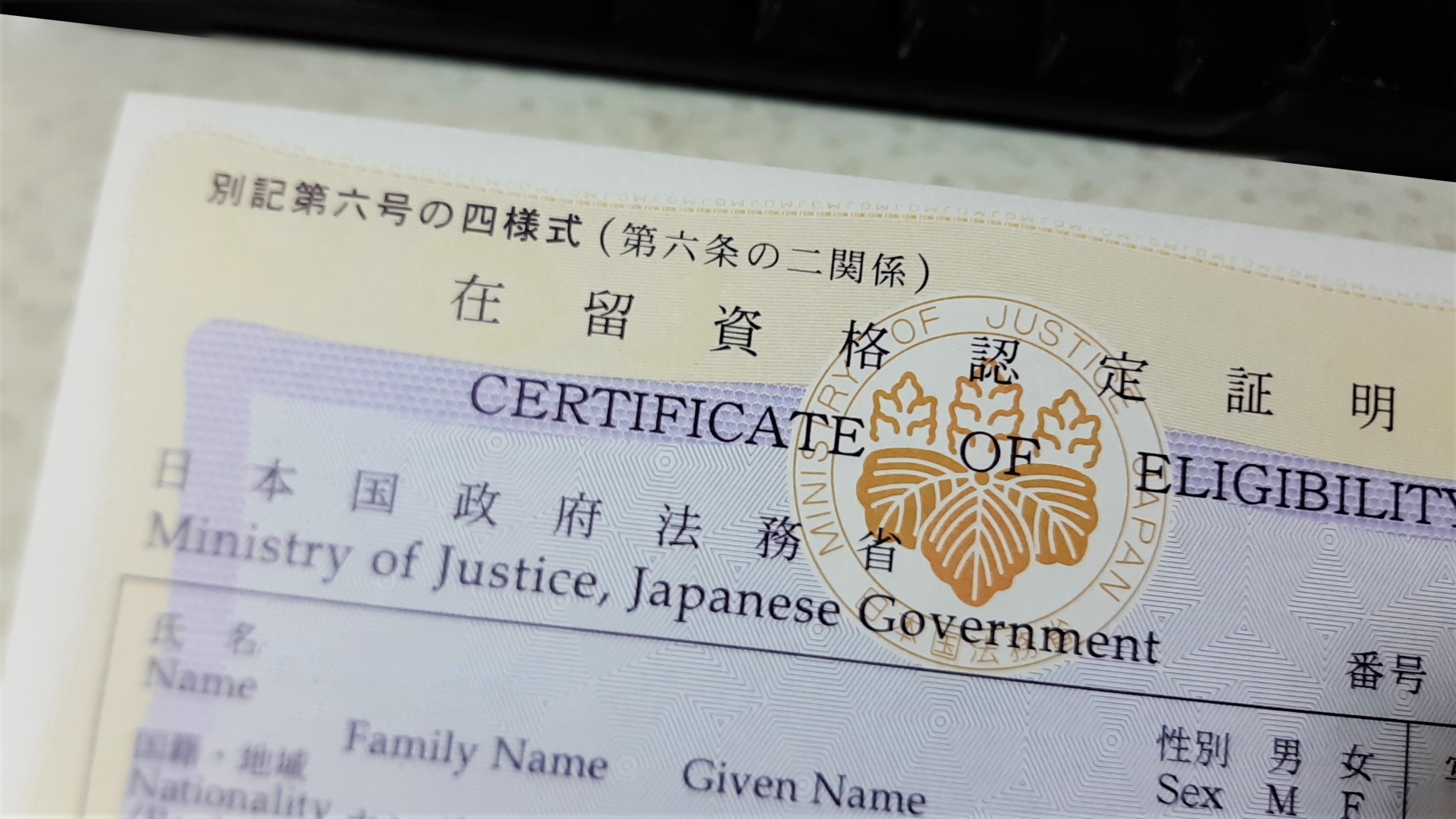
First, if you are coming to Japan from overseas to work, a “Certificate of Eligibility” will be issued. Since the person working lives overseas, the company will apply for the “Certificate of Eligibility” on his/her behalf.
The place to apply is the Immigration Bureau (the local Immigration Bureau that has jurisdiction over the location of the company where the employee works). Once the documents are completed, they will be sent to you and the subsequent procedures will be carried out in contact with the company.
The method of changing status of residence is called “Application for Change of Status of Residence”.
For example, a foreign student may change his/her status of residence from “College Student” to “Engineer/Humanities/International Services”. If you do not switch your status of residence, you will not be able to work.
You may think that the method of switching is smoother, but there is also an examination for the application for change of status of residence.
Points to note
If you apply for a work visa, you are not guaranteed to be granted a work visa.
There are cases where an application may be denied due to irrelevance, false application, or incomplete documentation.
April is the hiring season in Japan, so the application process may take longer than expected due to the high volume of applications after February.
It can take a long time to apply, so please allow plenty of time for your application.
Work visas have an expiration date, so if you need to extend your visa, be sure to do so.
Even if the expiration date has passed after you have applied, if it is taking a long time to examine your application, they may offer you a special period of time.
Conclusion
This is an introduction to the work visa requirements for foreigners working in Japan.
A work visa is required to work in Japan.
It may take some time to apply for a work visa, so be sure to apply well in advance.